
Illegal Detention and Abuse of U.S. Citizen in Punjab

By
Ensaaf Team
Apr 15, 2015
5 min read
Authors
No items found.
Attached Files
Join Our Newsletter
By subscribing, you agree to our Privacy Policy and ToS.
Thank you! Your submission was successful!
Oops! There was an error with your submission.
Share

On April 15, 2015, Ensaaf reached out to Congressmen and Senators on behalf of U.S. citizen Ravinderjeet Singh. The letter discusses the threats, false charges, illegal and arbitrary detention, and physical abuse suffered by Ravinderjeet Singh by government and security forces in Punjab, India.

Additional Resources

Explore Our Findings

Stay informed through our evidence-based research and advocacy on human rights.

Advocacy
5 min read

Kulvir Singh Barapind

Adopted in December 1984, the United Nations Convention Against Torture and Other Cruel, Inhuman and Degrading Treatment or Punishment (CAT), prohibits nations from extraditing individuals who are more likely than not to be tortured upon return. Ensaaf pursued the commitments promised in the Convention on behalf of Kulvir Singh Barapind.
Publications
5 min read

Release - Violent Deaths and Enforced Disappearances During the Counterinsurgency in Punjab, India

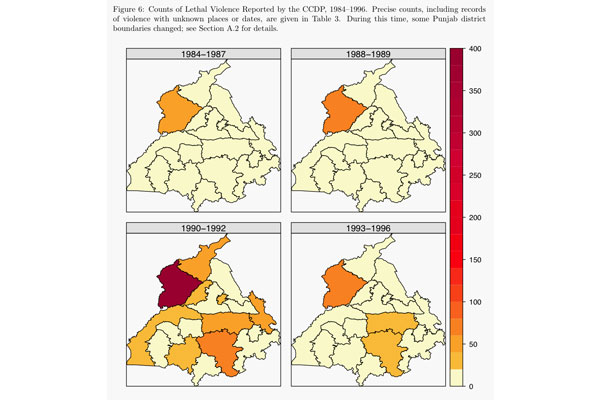
The report by Ensaaf and HRDAG, “Violent Deaths and Enforced Disappearances During the Counterinsurgency in Punjab, India,” presents empirical findings suggesting that the intensification of counterinsurgency operations in Punjab in the early 1990s was accompanied by a shift in state violence from targeted lethal human rights violations to systematic enforced disappearances and extrajudicial executions, accompanied by mass “illegal cremations.” Indian security officials have dismissed claims of human rights violations as unavoidable “aberrations” during the counterinsurgency against alleged terrorists in Punjab from 1984 to 1995.
Advocacy
5 min read

Expert Medical Study Documents Torture and Psychological Trauma Suffered by Families of the “Disappeared” in Punjab

In May and June 2005, Ensaaf organized the Physicians for Human Rights and the Bellevue/NYU School of Medicine Program for Survivors of Torture to conduct a study of 127 families who survived the disappearance of a family member in Amritsar, Punjab.